The artistic science of egg decorating!
At Science Club just before Easter, we marbled some eggs with wax.
We hung the decorated eggs on an Egg Tree.
Blown eggs
First of all we needed to make some hollowed out or 'blown' eggs. To blow an egg, you need to make a small hole in the top and a larger hole in the bottom, then blow hard through the small hole to force air into the egg shell. The air that you blow in to the top of the shell pushes all the egg white and yolk out of the bottom hole.
Making holes in eggs is a bit tricky but gets easier with practice. (Get an adult to do it, then it is their fault if they break the egg!) You can make the small hole with a sharp needle, and the larger hole by scratching a circle about 5mm across in the egg with the end of a sharp knife, then very carefully chipping out the shell from inside the circle.
Poke the needle through both holes to break the egg membrane before blowing into the egg.
If you do this at home, try not to get egg in your mouth, as there is a (very small) chance that raw eggs could contain salmonella bacteria. Salmonella can make people very ill, especially if they are very old or young, so children are usually advised not to eat uncooked eggs.
Blown eggs are a bit fragile. Handle with care, or you might have to make extras and end up eating more scrambled egg / omelette than you intended!
Melting wax
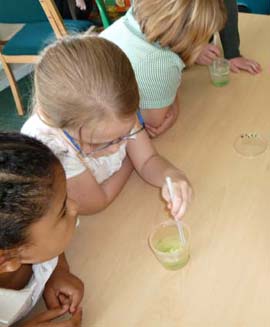
Finding the melting point of wax
Now we wanted to coat our eggs with melted wax, so first we needed to find out what temperature a piece of wax crayon would melt at. We filled several beakers with water at different temperatures and measured the exact temperature of the water using a thermometer. Then we dropped small pieces of crayon into each beaker.
Below 30°C the crayon didn't melt at all. At 50°C it melted quite slowly. At 70°C it melted very quickly.
Normal human body temperature is 37°C. That's the temperature inside you, so your skin can be cooler, but your hand is still usually warmer than 30°C. If a crayon melted at 30°C, it would melt in your hand and be no good for colouring with!
Marbling the eggs
For this you need:
- A clean plastic tub like a margarine tub, about 2/3 full of hot water.
- Wax crayons. 'Sharpen' the crayon with a pencil sharpener over a paper plate and collect all the little wax crayon shavings.
- A blown egg and a teaspoon.
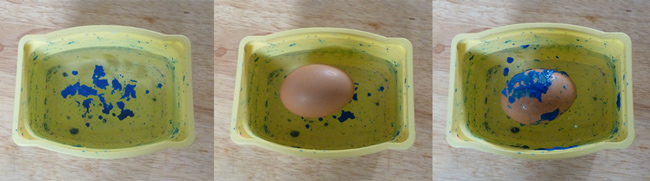
What to do:
- Tip a small pile of crayon shavings into the margarine tub, wait until they start to melt.
- Place the egg onto the melted wax and stir it around with the teaspoon. Sprinkle more crayon shavings over any bits of the eggshell that aren't covered, then keep twirling the egg in the water to melt the wax onto it. Continue until you're happy with the pattern.
- Carefully spoon out the egg and drop it into a bowl of COLD water to set the wax.
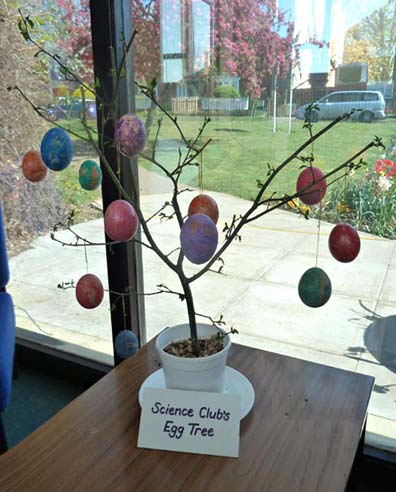
Our finished tree
Now you can thread some string through the top of your egg to hang it up. This is easiest with a long needle!
Our eggs were mostly single-colour ones but you can experiment with mixing the colours, or marbling the egg with first one colour and then another. You can get some very pretty effects. Be warned that too many colours mixed together are likely to give a muddy grey/brown...
Happy Easter!